In 1974 four known wild Mauritius kestrels were left in the world. This is how the kestrel, the echo parakeet and the pink pigeon were brought back, what keeping them alive still costs, and where the work is visible today.
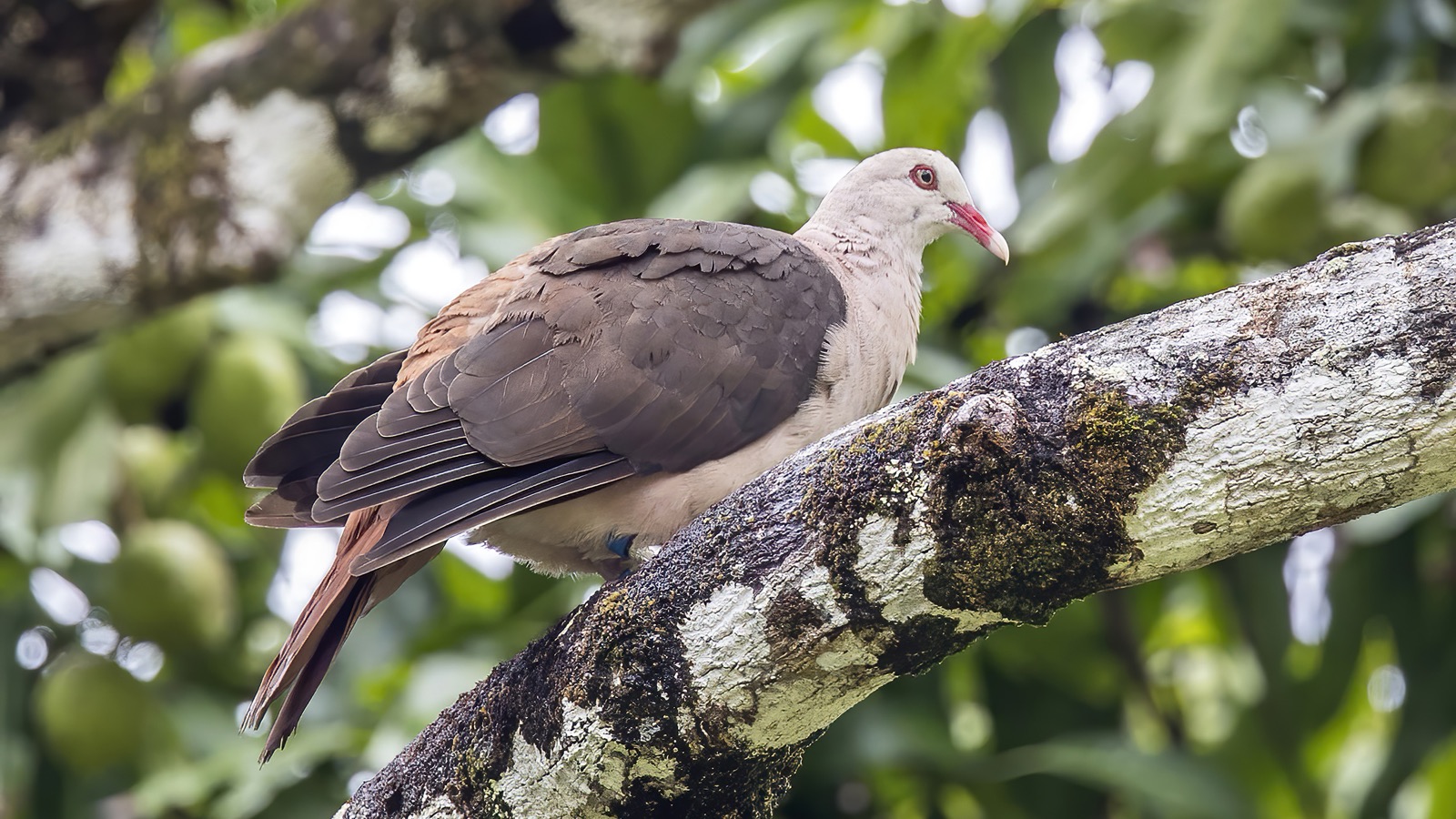
A pink pigeon on a lichen-covered branch in the Ferney valley, south east Mauritius. Photograph by Charles J. Sharp, licensed CC BY-SA 4.0.
In 1974 four known wild Mauritius kestrels were left in the world. The Mauritian Wildlife Foundation describes four known birds including a single breeding female, while BirdLife International counts four confirmed individuals including one breeding pair. A falcon found nowhere else on earth had been reduced to a number you could hold in your head. On 12 March 2022 that same bird was declared the national bird of Mauritius.
The echo parakeet and the pink pigeon came back from comparable depths, and other endemic birds are still on the edge. This is the story of how any of them survived.
Good to know
FAQ
How many Mauritius kestrels are left in the wild?
It depends on what is being counted and when. The IUCN Red List records 140 to 170 mature individuals from a 2018 estimate, and that measure counts breeding age birds only. The Mauritian Wildlife Foundation's 2024 annual report gives around 250 to 300 birds of all ages, and a 2023 BirdLife International feature described about 350 wild birds. Those are not the same measure and cannot be added into one range. The fair summary is a few hundred birds in total, with fewer than 200 of breeding age on the Red List's reckoning, and the trend is downward rather than upward.
Where can you see endemic birds in Mauritius?
Black River Gorges National Park in the south west holds most of the mainland populations, and the Mauritian Wildlife Foundation says pink pigeons can easily be seen at Petrin and in the Lower Gorges. Ile aux Aigrettes, reached by boat from Pointe Jerome and visited only on the Foundation's guided programmes, holds pink pigeons, Mauritius fodies and the olive white-eye. No sighting is ever guaranteed.
Is the pink pigeon still endangered?
It was downlisted from Endangered to Vulnerable in 2018 and the 2021 Red List assessment kept it there with a stable trend. That is progress rather than safety. A 2022 study found genetic variation falling quickly despite the rebound in numbers, and its authors argue that continued conservation work and further genetic rescue using captive bred birds from zoos are needed.
What is actually being done to protect Mauritius birds?
The practical work is unglamorous and continuous. Plots of native forest are fenced against deer and pigs and weeded by hand, rats and other introduced predators are held down by dense grids of traps, artificial nest boxes replace scarce or unsafe natural cavities, some populations are fed year round, and eggs and chicks are rescued or reared when a nest is failing. The Mauritian Wildlife Foundation and the National Parks and Conservation Service run this together, with support from partners including the Durrell Wildlife Conservation Trust.
Why the birds declined
Mauritius lost its forest early and lost almost all of it. Selective logging for ebony began in 1598, clearance for farming and settlement followed colonisation in 1638, and most of the island's cover had gone by 1935. The last large clearance came in the 1970s, when a World Bank funded scheme replaced native upland forest with pine. The government's 2010 report to the Convention on Biological Diversity put the surviving reasonable quality native forest at about 2,600 hectares, under 2 percent of the island, and no more recent official figure has replaced it. BirdLife International uses a slightly lower figure of 1.3 percent for good quality native forest. The Forestry Service puts total forest cover of all kinds at about a quarter of the island, but almost all of that is degraded or planted.
In its 2010 report to the Convention on Biological Diversity the government named invasive species, ahead of anything else, as the most serious threat to native land biodiversity. Black rats take eggs and chicks and strip the seed crop that would replace the forest. Crab-eating macaques, brought by the Dutch around 1602 and put at 25,000 to 35,000 animals in 2022 by University of Mauritius ecologist Vincent Florens, raid nests and eat fruit before it ripens. Mongooses, feral cats and introduced house crows add to the pressure, and the crows are a recorded nest predator on Ile aux Aigrettes. Introduced plants work more slowly. A 2003 study found strawberry guava reaching densities of up to about seven million stems of 1.3 metres or taller per square kilometre, and thickets of traveller's palm, privet and Hiptage benghalensis leave a kestrel little room to hunt below the canopy. Organochlorine pesticides in the 1950s and 1960s brought a wave of decline of their own.
The Mauritius kestrel recovery
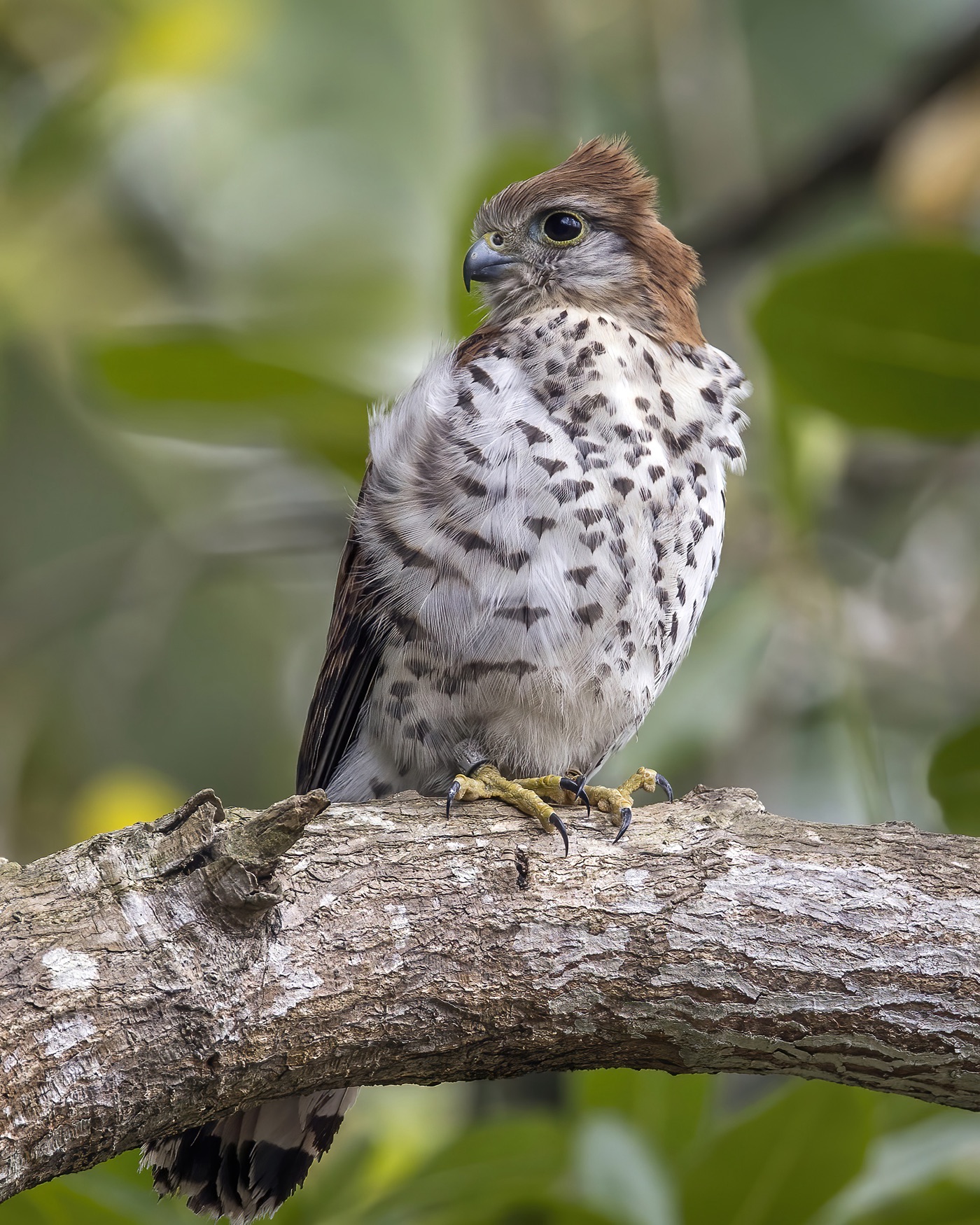
A Mauritius kestrel at Ebony Forest, Chamarel. Photograph by Charles J. Sharp, licensed CC BY-SA 4.0.
Research on the kestrel began in 1973, and an intensive programme ran from 1984 to 1994. What it involved is worth reading slowly. The programme combined captive breeding and restocking with supplementary feeding, better nest sites and artificial nest boxes, nest guarding, predator control around nests and release sites, moving eggs and chicks between clutches and broods, treating parasites on chicks, and rescuing eggs and young from failing nests. More than 300 captive bred birds went out over roughly a decade into the Black River Gorges and the Bambou Mountains.
The years since are less tidy than the rescue. Sources do not agree on when the population peaked or how high it went. BirdLife's species factsheet gives 350 to 500 individuals at the end of the 1990s, its own 2023 feature gives a high of 500 to 600 by the early 2000s, and the Foundation gives about 600 without naming a year, so the honest summary is a peak somewhere in the several hundreds. A fourth subpopulation in the Moka range died out by 2007, no captive bred birds were released at all between 1994 and 2016, and none went out in the 2023/24 or 2024/25 seasons. The Red List gives 140 to 170 mature individuals from a 2018 estimate on a decreasing trend, the Foundation's 2024 report gives around 250 to 300 birds of all ages, and a 2023 BirdLife feature described about 350 wild birds. The kestrel went back onto the Endangered list in 2014 and stayed there in 2023, and the Foundation states plainly that the species is in decline.
The echo parakeet
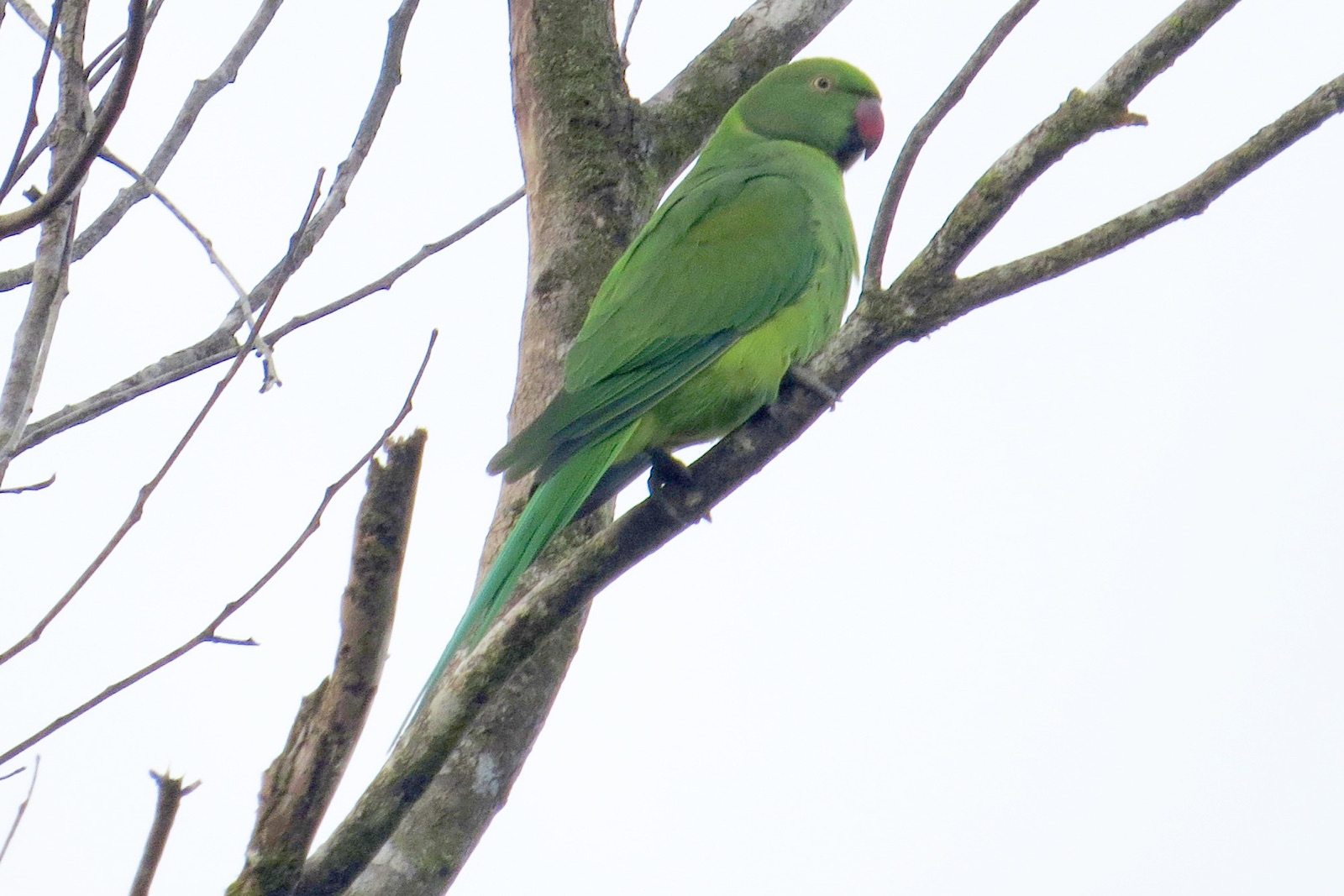
An echo parakeet near Le Pétrin, in the Black River Gorges. Photograph by Michael Hanselmann, licensed CC BY-SA 4.0.
The echo parakeet is the last endemic parrot left in the Mascarenes. Around 20 birds remained at the low point. BirdLife places that low point in the 1980s while the Foundation's own report puts it in the mid 1970s, and some popular accounts give a smaller figure again, so neither the number nor the decade is settled. From 32 individuals in 1996 the population reached an estimated 750 by 2019, through captive breeding, 139 birds released between 1997 and 2004, improved nest cavities, nest boxes first used for breeding in 2000, parrot pellets supplied consistently since 1997, and weeded management areas inside the Black River Gorges.
Management was deliberately eased in 2005 to slow the spread of Psittacine Beak and Feather Disease, and the population grew through the outbreak anyway. The Red List moved the species to Vulnerable in 2019 at 400 to 450 mature individuals. The Foundation's own figure for the whole population has been revised downward rather than upward, from over 800 birds in 2021 to over 700 in its 2023 report and over 600 in its 2024 report, so the most recent published estimate is also the lowest of the three. In the 2024/2025 season 180 known nest sites were checked, 380 eggs were laid and 159 chicks fledged, with macaques opening several nest boxes until extra security was fitted.
The pink pigeon
The pink pigeon fell to nine or ten known wild birds in 1990, depending on whether you follow the Foundation or BirdLife. It was pulled back with the same toolkit of captive breeding, release, weeded plots, predator control, supplementary feeding and disease control, and birds are still moved between subpopulations to spread genetic diversity. The Red List downlisted it to Vulnerable in 2018 and recorded a stable trend in 2021, on a deliberately wide band of 250 to 999 mature individuals built from 308 known birds in 2020. The Foundation puts the possible population at some 600 birds across eight managed sites by December 2024, which is also its own stated target for a minimum viable population, so it is best read as the Foundation's most recent estimate rather than a headcount.
Numbers are not the whole measure of safety. A 2022 study in Conservation Biology, whose authors include the Foundation, the Durrell Wildlife Conservation Trust and the National Parks and Conservation Service, found that genetic variation fell quickly even while the population rebounded. Its models project that the species would probably be lost from the wild within a century if the work stopped, which is a simulation rather than an observation. Three males were flown back from Jersey Zoo in September 2019, and two young reared in 2024 at the Gerald Durrell Endemic Wildlife Sanctuary carry both wild Mauritian and Jersey ancestry.
What conservation actually involves
Restoration here is mostly manual. A Conservation Management Area is a plot fenced against deer and pigs and then hand weeded of introduced plants. The government dates the major expansion of these plots to the 1980s onward, through collaborative work between the Mauritian Wildlife Foundation and the state conservation body, which became the National Parks and Conservation Service when that service was created in 1994. The weeded area is measured in tens of hectares against roughly 2,600 hectares of surviving native forest. The government's 2010 report put initial weeding at about 10,000 US dollars a hectare under the standard method, and at about 4,500 dollars a hectare where local labourers were recruited to work directly under National Parks supervision. Those are historical figures rather than today's prices.
Predator control has become measurable. At Brise Fer in the Black River Gorges the Foundation runs a mainland island, a block of forest under a dense grid of self-resetting traps, opened at 5.6 hectares in November 2018 and expanded to 9.75 hectares in 2021. Over 26 months to December 2020 the rat index inside averaged 13 percent against 63 percent in a control plot of the same size. The Foundation built it for the olive white-eye, and it also thinks it likely that pink pigeon breeding productivity rose at nearby Plaine Lievre because many territories there fall inside the trapped area, though it names a new feeding site at Petrin as another likely cause and ringing at Plaine Lievre fell back sharply in 2024. Much of the rest is routine that never ends, from some 138 kestrel nest boxes across the western and eastern populations to 22 feeding stations for the olive white-eyes on Ile aux Aigrettes.
The failures are part of the record
Not every release takes. Cuckooshrikes hand reared and released at Ferney between 2015 and 2018 were the first of their species raised that way, and none has been seen there since a single male answered a recording in November 2021. Ebony Forest at Chamarel collected 13 olive white-eye eggs in 2023/24, hatched every one and lost every chick during hand rearing. Those failures are published alongside the successes, which is much of why the successes are believable.
Where visitors can see the work
Black River Gorges National Park, proclaimed on 15 June 1994 and covering 6,574 hectares, holds nearly all the mainland recovery work, including most of the echo parakeets and most of the wild pink pigeon groups. Parakeets have deliberately been moved beyond it as well, to the Bambou Mountains in the east and to Ebony Forest at Chamarel, so that one local disaster cannot take the whole species. Around 60 kilometres of trails cross the park, including the Macchabee Forest Loop and the Parakeet Trail. The Foundation says pink pigeons can easily be seen at Petrin and in the Lower Gorges, although no wild bird is ever a certainty. Petrin carries a warning as well. Pigeons come down to the car park floor for food left by visitors, and several have been killed or injured by vehicles on the road towards Grand Bassin, so leave no food behind and drive slowly there.
Ile aux Aigrettes, a 26 hectare coralline island reserve off the south east coast, is the one place where several of the rarest species are concentrated into a small area, with pink pigeons, reintroduced Mauritius fodies and the Critically Endangered olive white-eye all present. The Foundation says a visitor is highly likely to glimpse a fody there and that it is now possible to glimpse the olive white-eye, though it put that island population at around 39 birds and declining in its 2024 report, so nothing is certain on any given day. The island is reached by boat from Pointe Jerome and can be visited only on the Foundation's guided programmes.
Andeor Editions
Bird watching with a guide
Andeor lists a guided bird watching walk in the Black River Gorges, starting from the Petrin Information Centre. Wild birds keep their own timetable and no sighting can be promised, but time in the right habitat, with someone who knows the calls, changes what you notice.